Coolant leaks don’t always announce themselves with a puddle and steam. A lot of them start as a slow seep that evaporates on a hot engine, then leaves behind a smell or a crusty residue that’s easy to ignore. The problem is that a small leak can turn into overheating, and overheating is one of the fastest ways to create expensive engine trouble.
If you catch the early clues, you can usually deal with it while it’s still a straightforward repair.
Why Small Coolant Leaks Are Easy To Overlook
The cooling system is pressurized when the engine is hot. That means a tiny crack or weak seal can leak only under pressure, then look dry once the car cools down. On top of that, coolant often lands on hot surfaces and burns off, so you don’t see a drip on the ground. People end up topping off the reservoir once in a while and hoping it was a one-time thing.
If you’ve had to add coolant more than once, it’s not a coincidence. The system is sealed, so the level shouldn’t be dropping regularly.
1. The Sweet Smell After You Park
Coolant has a distinct sweet smell, and it’s often the first clue. You might notice it after shutting the car off, especially if the leak is landing on a warm engine part. Some drivers only smell it in the garage. Others notice it when they walk past the front of the vehicle after a drive.
If you smell coolant and it keeps happening, don’t write it off as “just the car running hot.” That smell usually means coolant is escaping somewhere.
2. Crusty Residue Around Hoses And Plastic Housings
Even when the coolant evaporates, it leaves behind residue. Look for white, pink, or green crust depending on the coolant type. Common spots are hose connections, thermostat housings, plastic flanges, and seams near the radiator. Sometimes you’ll see a dried trail, like a drip line, that points back toward the source.
This is one of the most useful visual clues because it shows you where the leak has been traveling, even if you never see active dripping.
3. Heater Performance Changes Before The Temperature Gauge Moves
A lot of drivers assume overheating will always show up on the temperature gauge first. In reality, heater output can change earlier. If the heat starts blowing cooler at idle or takes longer to warm up, that can be a sign of a low coolant level or air pockets in the system.
Air in the system reduces heat transfer and can create hot spots, even if the gauge still looks normal. If your heater feels inconsistent and the coolant level has been dropping, those two clues often connect.
4. The Reservoir Level Keeps Dropping In A Pattern
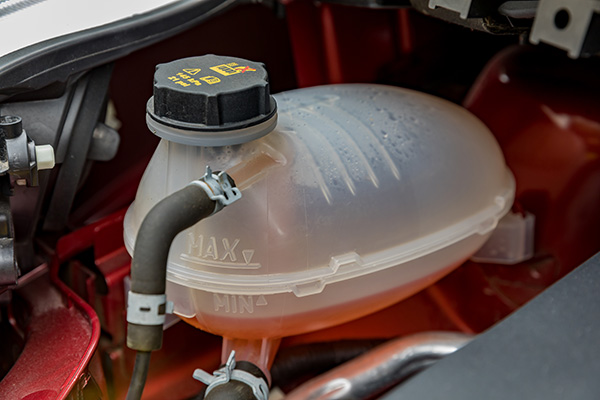
Some leaks are slow enough that you only notice the reservoir low every couple of weeks. That pattern is still important. A sealed cooling system shouldn’t need regular top-offs. If the level drops, then comes back up slightly after the engine cools, that doesn’t mean the problem is gone. It just means coolant expands when hot and contracts when cold, which can make the level look different depending on when you check it.
To track it accurately, check the level when the engine is cold and in the same parking spot. Consistency makes the pattern clearer.
5. Damp Spots Or Staining That Doesn’t Look Like A Fresh Puddle
Not all leaks leave a neat puddle. Sometimes you’ll see a damp spot on an undertray, a stained splash shield, or a slightly wet area near the radiator or subframe. Coolant can also leave a sticky feel if you touch the residue carefully with a glove.
If you notice dampness and you also smell coolant or see residue, that’s usually enough to justify a closer inspection.
Owner Mistakes That Turn A Small Leak Into A Bigger Problem
A common mistake is adding coolant repeatedly without finding the source. That can keep the car driving for a while, but it doesn’t prevent the day the leak suddenly worsens. Another mistake is mixing coolant types. Different coolant formulas don’t always play well together, and mixing can reduce corrosion protection or create deposits.
We also see people wait because the temperature gauge looks normal. That gauge is not a precision instrument, and by the time it moves, the engine may already be hotter than you want.
A Practical Plan To Catch A Leak Before It Escalates
If you suspect a leak, start by checking the level cold and monitoring it for a few days. Look for residue near hose connections and housings, and pay attention to smells after driving. If the car has an undertray, remember that leaks can collect and hide there, so a visual check from above isn’t always enough.
From a service standpoint, pressure testing is one of the fastest ways to find small leaks because it brings the system up to operating pressure without a long drive. Dye can also help when the leak is intermittent. The key is confirming the source so the repair actually solves the issue.
Get Cooling System Service in San Jose and Milpitas, CA with Alvin's Auto Center
If you’re smelling coolant, noticing the level dropping, or seeing residue around hoses or housings, it’s worth finding the source before overheating becomes the next surprise. We can test the cooling system, pinpoint where it’s losing coolant, and explain the repair options clearly.
Call Alvin's Auto Center in San Jose and Milpitas, CA, to schedule an inspection and keep your engine running at the right temperature.