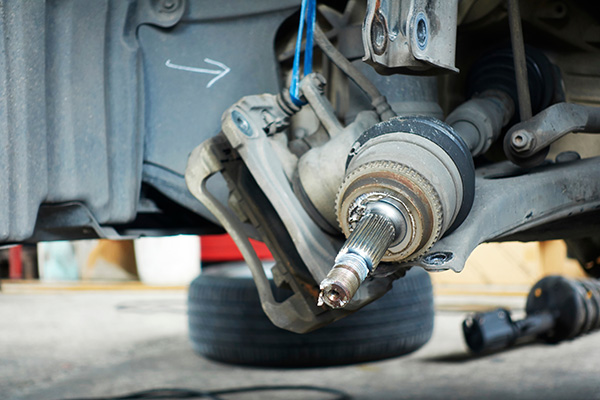
CV axles transfer power from the transmission or differential to the drive wheels while still allowing the suspension and steering to move. Each axle uses CV joints that can operate at changing angles without interrupting power delivery.
When those joints start wearing out, the symptoms usually become more obvious during turns, acceleration, or suspension movement. A damaged CV boot can also let grease escape and road debris enter the joint, which speeds up wear quickly. Catching the problem early can mean replacing one axle before the joint fails far enough to leave the vehicle unable to move.
1. You Hear Clicking or Popping During Turns
A repetitive clicking sound while making a tight turn is one of the most recognizable signs of an outer CV joint wearing out. The noise often gets louder when you accelerate through the turn because the joint is under more load.
You may notice it first in parking lots, U-turns, or when pulling into a driveway. At our shop, we listen for which side is making the noise and inspect the outer joint and boot for grease loss or damage. Clicking that repeatedly follows wheel speed is much more useful diagnostically than a single random pop from the suspension.
2. The Vehicle Shudders or Vibrates Under Acceleration
A worn inner CV joint can create a vibration or shudder when you accelerate, especially from a stop or at lower road speeds. The vibration may become weaker when you lift off the throttle because drivetrain load is reduced.
This symptom is sometimes mistaken for a tire balance problem, but tire vibration usually depends more on vehicle speed than throttle position. If the shake appears mainly while power is being applied, we look closely at the inner CV joints, axle shafts, engine mounts, and other driveline components before blaming the wheels.
3. Grease Is Splattered Around the Inside of a Wheel
CV joints are packed with special grease and protected by flexible rubber boots. If a boot cracks, tears, or comes loose from its clamp, the spinning axle can throw grease onto the suspension, wheel, brake backing area, or underside of the vehicle.
A torn boot does not always mean the CV joint has already failed. If you catch it early and the joint hasn't been contaminated or damaged, there may be more than one repair option, depending on the vehicle. Once the grease has been gone for a while and dirt has entered the joint, replacing the complete axle is often the more dependable choice.
4. You Hear Clunking When Shifting Between Drive and Reverse
A worn CV joint can develop extra internal clearance. When the drivetrain load changes direction, that looseness can create a clunk as the joint takes up the slack.
You may hear it when moving from reverse to drive, when getting on and off the accelerator, or when pulling away from a stop. CV joints are not the only parts that can create this sound. Worn engine mounts, transmission mounts, differential components, and other driveline parts can feel very similar, so you need an inspection before replacing an axle based on clunking alone.
5. The Car Feels Like It Is Binding or Jerking in Tight Turns
A severely worn CV joint can stop moving smoothly through its full range of motion. Instead of quietly changing angle as the wheels turn, the joint can bind, jerk, or feel rough.
This is a later-stage warning we take seriously. If the joint is already binding under steering load, continued driving can lead to rapid deterioration. A CV joint that comes apart internally can stop transferring power to the wheel, and on some vehicles that means the car will no longer move even though the engine and transmission are still operating.
A Damaged Boot Can Shorten Joint Life Quickly
The CV boot is simple, but it is critical to the joint's life. Its job is to keep grease inside while keeping water, grit, and road debris out.
Heat, age, road damage, and constant flexing eventually weaken the rubber. Regular maintenance gives us a chance to spot small cracks, loose clamps, or early grease seepage before the joint runs dry. Once the boot is torn wide open, every mile allows more contamination into a precision joint that depends on clean lubrication.
Replace the Axle Before the Joint Fails Completely
CV joint noise tends to get worse rather than repair itself. A mild click can turn into louder popping, vibration, and eventually a joint that can no longer carry engine torque.
We check both sides because one failed axle does not automatically mean the other needs replacement. Mileage, boot condition, joint play, and symptoms all help determine what actually needs service. If only one axle is worn, replacing that axle and monitoring the other side is often the sensible repair, rather than replacing parts simply because they are the same age.
Get CV Axle And CV Joint Service In San Jose and Milpitas, CA, With Alvin's Auto Center
If your vehicle clicks during turns, vibrates under acceleration, leaks CV grease, or clunks when drivetrain load changes, Alvin's Auto Center can inspect the axles and CV joints at its San Jose and Milpitas, CA locations.
Schedule a CV axle check before a worn joint progresses to the point where it can no longer transfer power to the wheels.