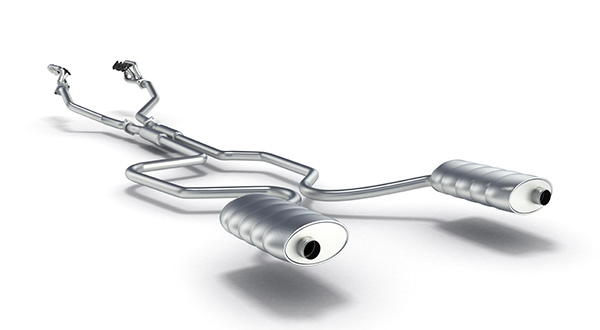
The number of visible exhaust pipes does not tell you exactly how powerful, efficient, or expensive a vehicle is. Some engines operate with one complete exhaust path, while others use two separate paths or split one system into two outlets near the rear bumper.
Exhaust design depends on engine layout, airflow needs, available space, sound targets, emissions equipment, and appearance. Two tailpipes may indicate a true dual-exhaust system, but they may also be connected to a single pipe farther forward.
What The Exhaust System Does
The exhaust system carries burned gases away from the engine and passenger compartment. It also reduces sound, supports emissions control, and helps the engine operate within its intended airflow range.
A typical system may include:
- Exhaust manifolds or headers
- Turbocharger outlets on equipped engines
- Catalytic converters
- Oxygen sensors
- Exhaust pipes
- Resonators
- Mufflers
- Tailpipes
Each section is sized and positioned for the engine and vehicle. Pipe diameter, converter capacity, muffler design, and routing all influence exhaust flow, noise, heat, and emissions performance.
Why Many Cars Use A Single Exhaust Pipe
A four-cylinder engine usually produces less exhaust volume than a large V6 or V8 under similar operating conditions. One correctly sized pipe can carry the exhaust without creating excessive restriction, making a second path unnecessary.
A single system also has several practical advantages. It generally weighs less, costs less to manufacture, takes up less space beneath the vehicle, and requires fewer joints, hangers, heat shields, and muffler components.
Front-wheel-drive cars often have crowded underbody layouts. The fuel tank, rear suspension, spare tire area, brake lines, and body structure leave limited room for exhaust routing. A single pipe allows engineers to place the system safely away from fuel components and moving suspension parts.
What A True Dual-Exhaust System Means
A true dual-exhaust system keeps exhaust from two cylinder banks separated through much or all of the vehicle. This layout is common on some V6 and V8 engines because each side of the engine has its own exhaust manifold.
Each bank may have its own catalytic converter, oxygen sensors, pipe, resonator, muffler, and tailpipe. Keeping the paths separate can increase total exhaust capacity when the engine produces enough airflow to require it.
Some dual systems include a crossover pipe between the two sides. An H-pipe or X-pipe allows pressure pulses to interact and can improve exhaust scavenging, sound quality, or torque characteristics. The exact result depends on pipe sizing, crossover placement, engine firing order, and the rest of the exhaust design.
Two Tailpipes Do Not Always Mean True Dual Exhaust
Many vehicles have two visible outlets but only one main exhaust path. The system may use one pipe and one muffler before splitting into two short tailpipes near the rear bumper.
This arrangement is often called a dual-outlet exhaust rather than a true dual system. It can help create a balanced appearance, fit a specific bumper design, or change the exhaust note without requiring two complete systems from the engine rearward.
Some decorative outlets are not connected in the way drivers expect. The actual exhaust may exit through a smaller pipe beneath the bumper while larger trim pieces create the appearance of dual exhaust. Looking underneath the vehicle reveals whether both outlets carry exhaust gases.
Does Dual Exhaust Increase Horsepower?
A dual system can support greater airflow when the original exhaust is restrictive, and the engine can use the additional capacity. Large engines, turbocharged engines, and performance applications may benefit from reduced backpressure when pipe size and routing are engineered correctly.
Installing extra pipes does not automatically increase power. Exhaust velocity and pressure-wave behavior are important, especially at lower engine speeds. Pipes that are too large can reduce low-speed response and create unwanted noise without producing a useful performance gain.
Modern vehicles also rely on oxygen sensors, catalytic converters, turbocharger controls, and engine computer calibration. Modifying the exhaust without considering these systems can trigger warning lights, alter fuel control, create leaks, or reduce emissions performance.
Why Some Small Engines Have Two Outlets
A vehicle with a small engine may have two tailpipes for appearance or sound rather than airflow demand. Automakers use exhaust outlets as styling elements, especially on sport trims.
Two outlets can make the rear of the car look wider or more balanced. They may also allow a muffler to use two smaller exits instead of one larger opening. The number of outlets alone does not confirm engine size or performance.
Hybrid vehicles and lower-output engines may also use dual-looking trim even though exhaust flow is modest. The vehicle’s specifications and underbody layout provide more reliable information than the bumper design.
Common Exhaust Problems To Watch For
Single and dual systems develop many of the same faults. Heat, vibration, moisture, road salt, and impact damage can weaken pipes, welds, flanges, and hangers.
Warning signs include:
- Rattling beneath the vehicle
- A louder exhaust note
- Ticking during acceleration
- Exhaust odor inside or near the cabin
- Rust holes or cracked welds
- Loose tailpipes
- Reduced engine power
- A check engine warning light
A leak near the front of the system can allow hot gases to damage wiring, hoses, and nearby components. Exhaust entering the cabin creates a carbon monoxide risk and requires immediate attention.
How Exhaust Problems Are Tested
Technicians inspect the system from the engine to the tailpipe, checking manifolds, flex sections, converters, shields, hangers, mufflers, and joints. Soot marks often show where gases are escaping, while tapping or controlled movement can reveal loose internal parts.
Diagnostic testing may also include oxygen sensor data, converter efficiency information, exhaust backpressure measurements, and smoke testing. An inspection confirms whether a noise comes from a leaking pipe, broken hanger, loose heat shield, damaged converter, or internal muffler failure.
Get Exhaust System Service In San Jose And Milpitas, CA, With Alvin's Auto Center
Alvin's Auto Center serves drivers in San Jose and Milpitas, CA. Our team can inspect single- and dual-exhaust systems, locate leaks, test restricted components, and repair damaged pipes, mufflers, converters, and hangers.
Contact us to schedule exhaust service when your vehicle becomes louder, develops an odor, or loses performance.